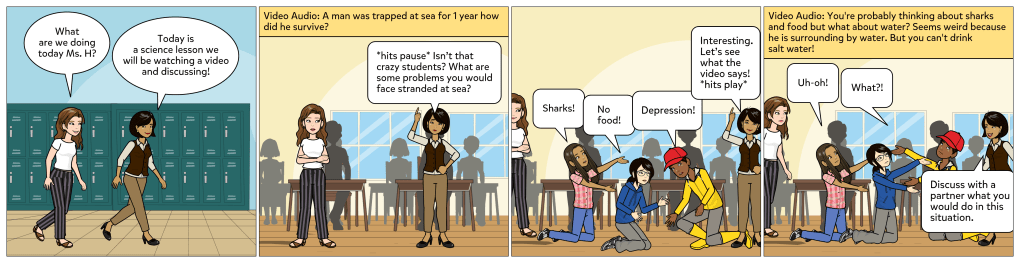
Distributed cognition refers to, “the role that mediating artefacts play in human cognition,” (Morgan et al 2008). In the scenario projected above, the mediating artefact is a video about a man stranded at sea for a whole year. However, a mediating artefact can be a whole range of tools such as, “instruments on an aircraft to procedures that are employed in certain situations, to a range of signs and symbols such as language and mathematics.” (Morgan et al. 2008 p.127) This video had engaging audio, visuals, and specific places designated for pauses where students can have a discussion. Mediating artifacts should involve this type of social and physical context so that the students as well as their, “surrounding resources” are all involved in this activity. Cognition is not just internal but external and takes place in the context of activity. Mediating artefacts and the environment therefore go hand in hand for distributed cognition. In this example, the environment includes the small group or partner through which students have discussions regarding the video. The discussions about the video satisfy the most basic requirement for coordination in which, “it must be possible for information to pass through the systems.” (Martin 2012 p.92) Without the video the students may never have heard the story of the man at sea without which conversation and connection between students would not be facilitated in the same way. Furthermore, with this connection between the video to the students and teh students to each other is an example of translation. Even students speaking to each other information is translated many times, “from linguistic thought patterns, to motor programs, to movements of the respiratory and articulatory systems, to sound waves, to movement of the listener’s ear bones to electrical signals, and again into mental information.” (Martin 2012 p.92). The video itself is an example of off-loading. The teacher did not have to do research on a true story, generate visuals, or write the lesson plan on salt water. If that were the case it is possible that they would have become overloaded which can make a cognitive system “unmodifiable.” Instead, offloading allows increased efficiency and potential for learning (Martin 2012 p.92). The teacher could focus instead on facilitating discussion that was productive and thought provoking. The offloading allowed more monitoring capability for the teacher. Monitoring refers to, “the function of assessing the quality of the coordination between systems and providing this information as feedback,” (Martin 2012 p.92). Thanks to offloading she could focus on monitoring in the form of listening to the students discussions and assess their critical thinking skills. I would argue this incorporation of technology did indeed enhance students learning and make them smarter. For all of the above stated reasons, the connection between students and videos, the distributed cognition in the group environment, and the offloading that allowed for monitoring.
 ED 386 Educational Technology- Kate