Distributed Cognition 2

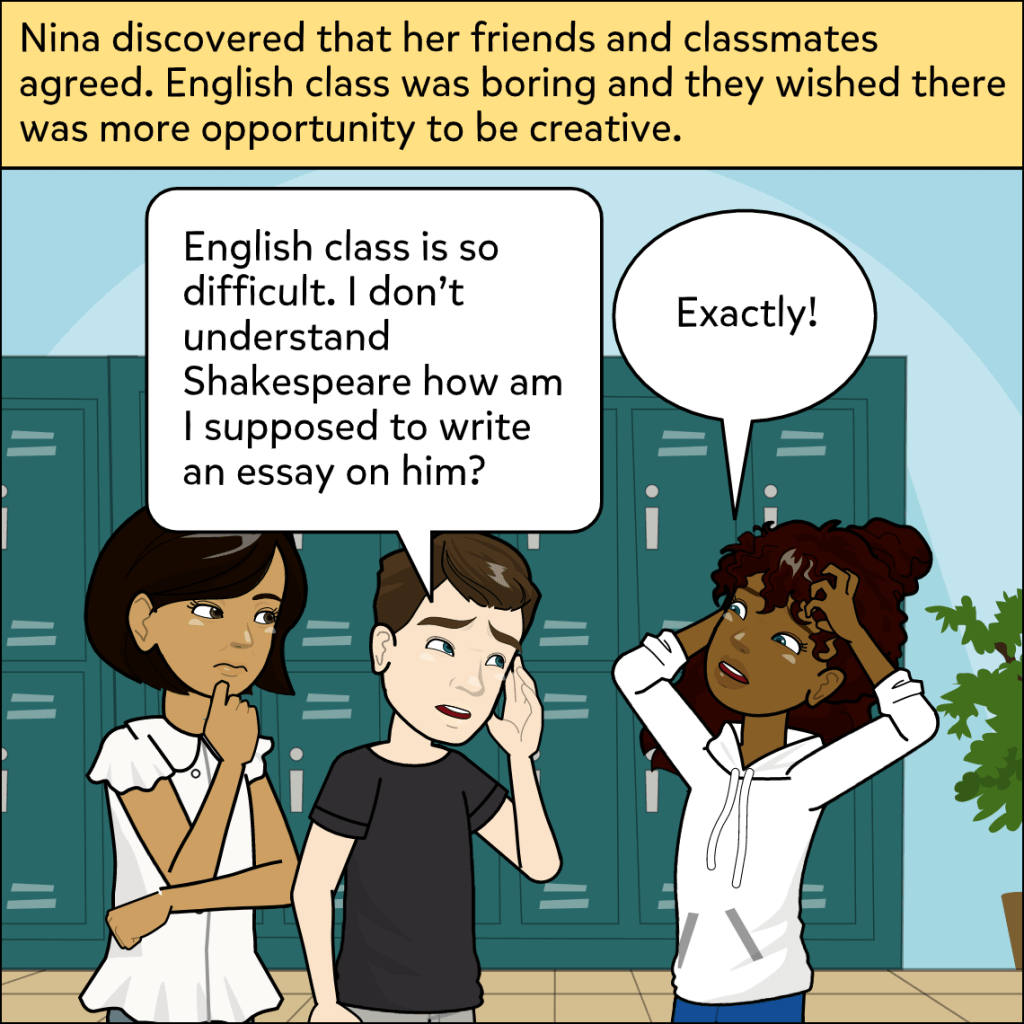
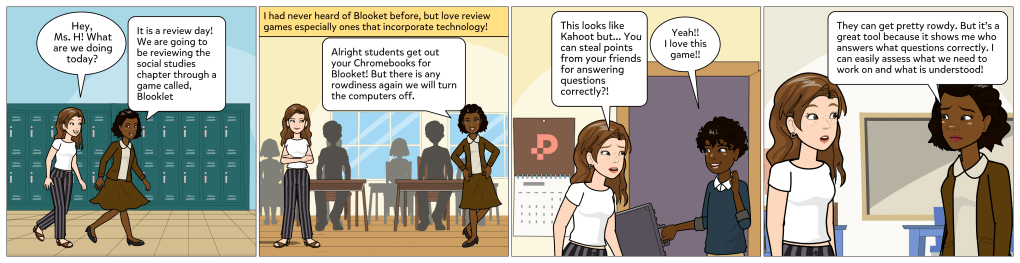
As aforementioned in the previous blog post distributed cognition is defined as  “the role that mediating artefacts play in human cognition,” (Morgan et al 2008). The process of learning is a complex one and in the article by researcher Martin they attempt to describe it through metaphors. Previous research conceptualized the process of learning as “learning as acquisition and learning as participation.” However, Martin offers an alternative metaphor in order to better suit distributed cognition of, “learning as coordination,” (Martin 2012 p.90). In this comic I am detailing a specific day where the students were using the website Blooket. This site is a review game similar to Kahoot where students are provided with multiple choice question and answers and earn points for correct answers. The leaderboard is displayed on the screen or in this case SmartBoard so student’s can see everyones progress and competition. The distinciton between Blooket and Kahoot is that in Blooket you don’t only recieve points for answering questions correctly but you can also steal your classmates points. This led to much yelling and disagreements. This leads to the question of facilitators of coordnation. If learning as coordination is a metaphor for learning then we need to question “what processes facilitate coordination between two distinct cognitive systems,” (Martin 2012 p.91). This technology clearly serves a connection by linking students scores together. Information is passing both between the computers and between the students mind and the computer. However, the question comes to mind that was not answered in the article; what is the effect of connection if properly defined by information passing between the systems but yet causes fractures between the systems? Does the benefit still exist? I would argue it depends on the extent of the fracture. In this classroom I would argue the connection is still beneficial even though some disagreements broke out. The students were connected and motivated by competition through technology.

An additional concept to be discussed is the difference of “effects with technology” versus “effects of technology.” Effects with technology emerge through the interaction when certain intellectual functions are downloaded onto the technology,” Effects of technology concern, “effects, positive or negative, that persist without the technology in hand, after a period of using it,” (Salmon and Perkins 2005). This review game indeed creates positive effect that persist without the technology in hand. The students will still remember the review answers after their Chromebook’s are closed thanks to the repetition of review answers.

This technology is certainly an example of offloading. The Blooket system records students answers to question and records class accuracy score. This will allow the teacher to get accurate data concerning the students knowledge or lack there of. She will not have to do any complicated math or physically record scores to review. Addiotionally, this feature also allows for Monitoring in the most basic way that the teacher can monitor students progress. This is vital because, “without monitoring, coordination might contain significant mismatches, or might be incomplete,” (Martin 2012 p.93-95). Overall, this use of technology in the classroom was beneficial and indeed advanced student learning. Students were motivated by the competition of the system and reviewed terms they should have prior knowledge. Students and teachers alike benefit from the assessment tool in order to not waste time reviewing known facts or rather miss the outliers of questions answered incorrectly.
Distributed Cognition 1

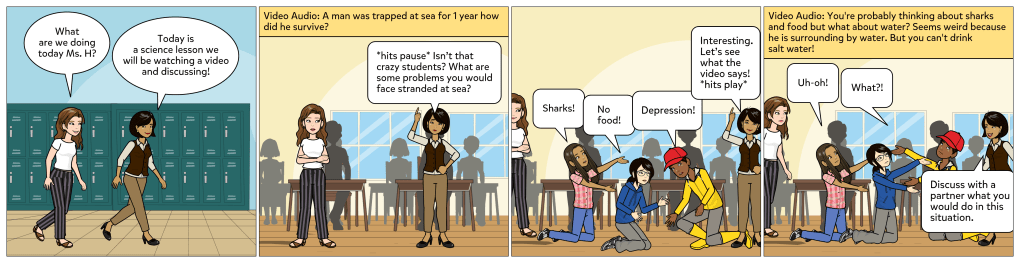
Distributed cognition refers to, “the role that mediating artefacts play in human cognition,” (Morgan et al 2008). In the scenario projected above, the mediating artefact is a video about a man stranded at sea for a whole year. However, a mediating artefact can be a whole range of tools such as, “instruments on an aircraft to procedures that are employed in certain situations, to a range of signs and symbols such as language and mathematics.” (Morgan et al. 2008 p.127) This video had engaging audio, visuals, and specific places designated for pauses where students can have a discussion. Mediating artifacts should involve this type of social and physical context so that the students as well as their, “surrounding resources” are all involved in this activity. Cognition is not just internal but external and takes place in the context of activity. Mediating artefacts and the environment therefore go hand in hand for distributed cognition. In this example, the environment includes the small group or partner through which students have discussions regarding the video. The discussions about the video satisfy the most basic requirement for coordination in which, “it must be possible for information to pass through the systems.” (Martin 2012 p.92) Without the video the students may never have heard the story of the man at sea without which conversation and connection between students would not be facilitated in the same way. Furthermore, with this connection between the video to the students and teh students to each other is an example of translation. Even students speaking to each other information is translated many times, “from linguistic thought patterns, to motor programs, to movements of the respiratory and articulatory systems, to sound waves, to movement of the listener’s ear bones to electrical signals, and again into mental information.” (Martin 2012 p.92). The video itself is an example of off-loading. The teacher did not have to do research on a true story, generate visuals, or write the lesson plan on salt water. If that were the case it is possible that they would have become overloaded which can make a cognitive system “unmodifiable.” Instead, offloading allows increased efficiency and potential for learning (Martin 2012 p.92). The teacher could focus instead on facilitating discussion that was productive and thought provoking. The offloading allowed more monitoring capability for the teacher. Monitoring refers to, “the function of assessing the quality of the coordination between systems and providing this information as feedback,” (Martin 2012 p.92). Thanks to offloading she could focus on monitoring in the form of listening to the students discussions and assess their critical thinking skills. I would argue this incorporation of technology did indeed enhance students learning and make them smarter. For all of the above stated reasons, the connection between students and videos, the distributed cognition in the group environment, and the offloading that allowed for monitoring.

Access to Technology

I am currently at a k-8 school named Hilltop Elementary in a fourth grade classroom. Technology here is prevalent and I interviewed my cooperating teacher for this assignment. My teacher teaches mainly ELA , science and social studies for the fourth grade. The students use their chrome books more often than not. The copiers have been broken at the school all semester and therefore every single worksheet and activity in the school is done online. They also use Google Slides, Google Docs, Google Forms, Blooket, Kahoot, and Peardeck. 

The people at my school in charge of the technologies is a small computer maintenance team. The school has a 1:1 ratio of chrome books that they carry around from class to class with them. They can also take the chrome books home and are independently in charge of them. Each classroom also has a smartboard and  The technologies are readily available as each student has their own that they carry around and are in working order. If there is an issue a computer manager will take the computer and handle the issue and the student will be without a laptop for a short period of time. Teachers have access to view the students computers through GoGuardian. There is a small technology fee paid at the beginning of the year but students only have to pay for the laptop if they break it. The firewall blocks access to sites deemed inappropriate and can only be transcended or moved around by a computer technician. Most things are available including youtube and sites that may be considered time wasters, only inappropriate sites are blocked. As aforementioned I was speaking to my cooperating teacher who had basic knowledge of technology in the classroom. 

Observing Classroom Technology Use

The students in the classroom use an extraordinary amount of technology. Part of this reason may be to the shift of the digital age post COVID and I know for sure a large reason for it is because my cooperating teacher told me the copy machine has been down all year. She simply cannot use worksheets as she cannot make copies of them. I did notice her hand writing the assignment for two special ED students which I thought was a stellar example of altering the curriculum as needed for each student and kind of her to put so much work into handwriting the assignment. Students mostly used Chromebook and they all seemed fairly confident with the technology.

From what I observed there was two types of ways the students used their chrome books. The first was the teacher would lecture with an interactive activity on the board and students would follow along with her on their own devices, highlighting and interacting as instructed. The second way was independent work. They would write essays, fill out study guides, and play class games all independently. Most of the software used by the teacher weren’t programs but rather scanned PDF’s that would have been a physical worksheet being utilized or else a premade PowerPoint. However, when I was there on Monday the students were playing a review game called, “Blooket.” It was similar to Kahoot however you acquired points by choosing students to steal a percentage of their points as a reward for answering correctly. I foresaw many fights breaking out over this and indeed they did.

One way in which the hardware is impeding the conditions that make student learning possible is that mistakes are often made on virtual worksheets. Yesterday at least 5 students unknowingly deleted the word bank and didn’t understand that they deleted it or how to get it back. This would not happen if it was on a piece of printed paper. For my cooperating teacher, the technology like this review game allows offloading because she does not have to do anything but walk around the classroom. The game asks the questions, records students accuracy rates, and presents the results to the teacher. Overall, the classroom is loaded with technology in ways that both facilitate and impede the conditions that make student learning possible.

Digital Storytelling Script & Storyboard

Script

Slide 1

For me, education has always been about people. The friends I met at my k-8 school are the ones I still hold close today. In my 7+8th grade classroom, there were nine of us. (saint mary school videos) These nine people were truly my family and we still get together today for reunions (videos and pictures of being together)

Slide 2

When I went to highschool, that family atmosphere was missing. The halls were crowded and I felt like cattle being herded on their way to being slaughtered. I went from a class of 9 and a school of 150 to a class of 300 and a school of 2000. (overlapping chatter and voices and footsteps) 

Slide 3

I went from two teachers that knew me, my interests, hobbies, learning styles, and everything else- to teachers who didn’t know me. Some of them didn’t care to get to know me and immediately assumed the worst of me if I slipped up or made a mistake.

Slide 4

In these classrooms, I lost the family environment. I did not feel comfortable voicing my opinions or asking questions. 

Slide 5

When I started taking AP classes I regained some of the safety by being in classrooms with people who I recognized from other classes and teachers who expected more from me in the more rigorous classes rather than expecting the worst from me. 

Slide 6

I knew when I began searching for colleges that I wanted to find that same family environment that I had in my k-8 school and began to regain through AP classes.

Slide 7

 I wanted a small university where the teachers would know me and I would know them as well as my classmates. I knew if I felt safe with my classmates and professors I could not only excel in school but enjoy the process of learning again. 

Slide 8

My learning experience here has been invigorating and welcoming. I participate in classroom discussions and love studying with my friends and fellow classmates. Studying in a social setting keeps me engaged and motivated. 

StoryBoard 

Slide 1

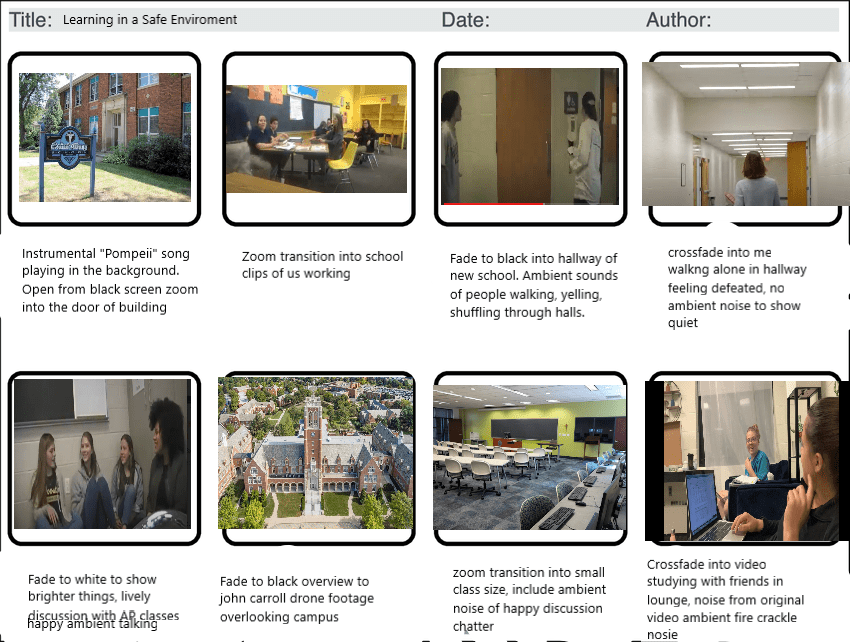
Begin with an instrumental version of the song Pompeii by Bastille. Begin scene with a black screen fading in on a picture of Saint Mary school which will then zoom into the building. Zooming in all the way representing entrance of school will use zoom transition into clips of video from us working at art, which will crossfade into dancing. Music in the background will be

Slide 2

Fade to black to transition into high school clips of people walking in the hallways with sound effects of loud overlapping chatter, footsteps, yelling, pushing 

Slide 3

Fade to black to go back to saint mary videos of teachers and then crossfade transition into clips of empty teacher desks with muffled audio of yelling 

Slide 4

Fade to black clip of me looking uncomfortable in a classroom, not speaking, not looking up with camera panning around me in circles to signify suffocation 

Slide 5

Fade to black and pause in black for a moment before fading from black into transition of clip of AP class, lively safe discussion talking noises in the background 

Slide 6

Fade to black into fade out from drone footage of john carroll, to crossfade transitions of small empty jcu classrooms

Slide 7

Crossfade to me smiling in JCU classroom cross fade to me and friends walking crossfade to me and friends on quad 

Slide 8 

Crossfade to clip studying in the lounge circling in a 360 perspective fade out to black and music fades with it. Credits roll.

Video Exploration: Florence

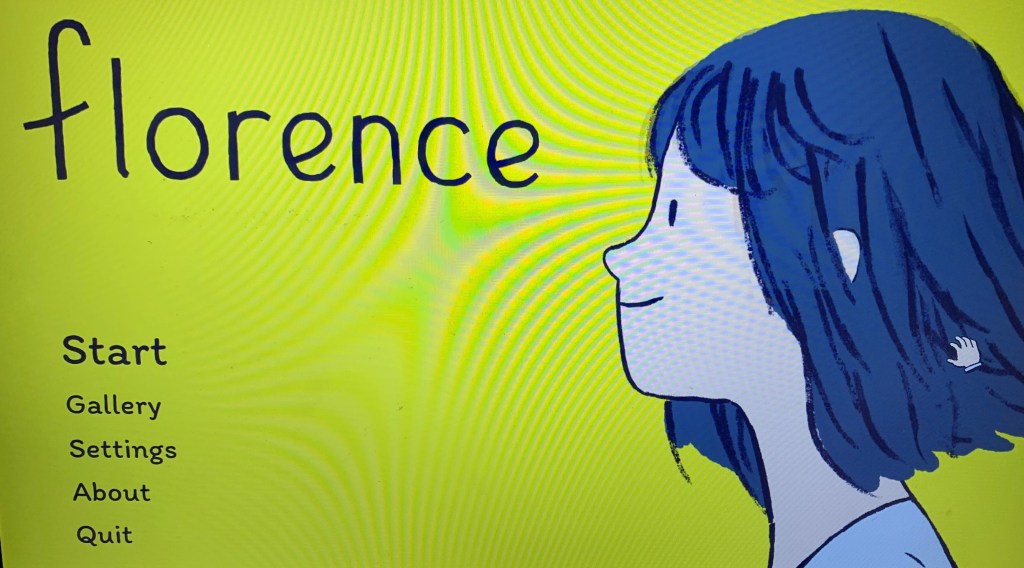
As my previous blog post mentioned I became so frustrated after working on the first step for over an hour on a video game that I gave up. The game was poorly designed in that I could not even figure out how to play the initial loading screen which was a sandbox. It was a poorly designed sandbox meant to teach the rules but instead it was a sandbox that was so confusing I had to give up. Not wanting to waste more time I decided to purchase a game in hopes that 5 dollars could guarantee a game that made a little bit more sense and was a little bit more user friendly. I discovered the game by doing a google search for story based games in hopes that I could use a the video game as a form of media literacy to teach elements of a story such as plot, dialogue, conflict, Freytag’s Pyramid etc. The google search led me to a game titled, Florence. The reviews for this game detailed exactly what I was looking for, “Though the game is only 30 minutes long, it has earned praise for its storytelling, character building, and art direction.” 30 minutes seemed like the perfect length for a classroom experience and I figured the students can benefit from exploring the concept of character development and archetypes through the game.

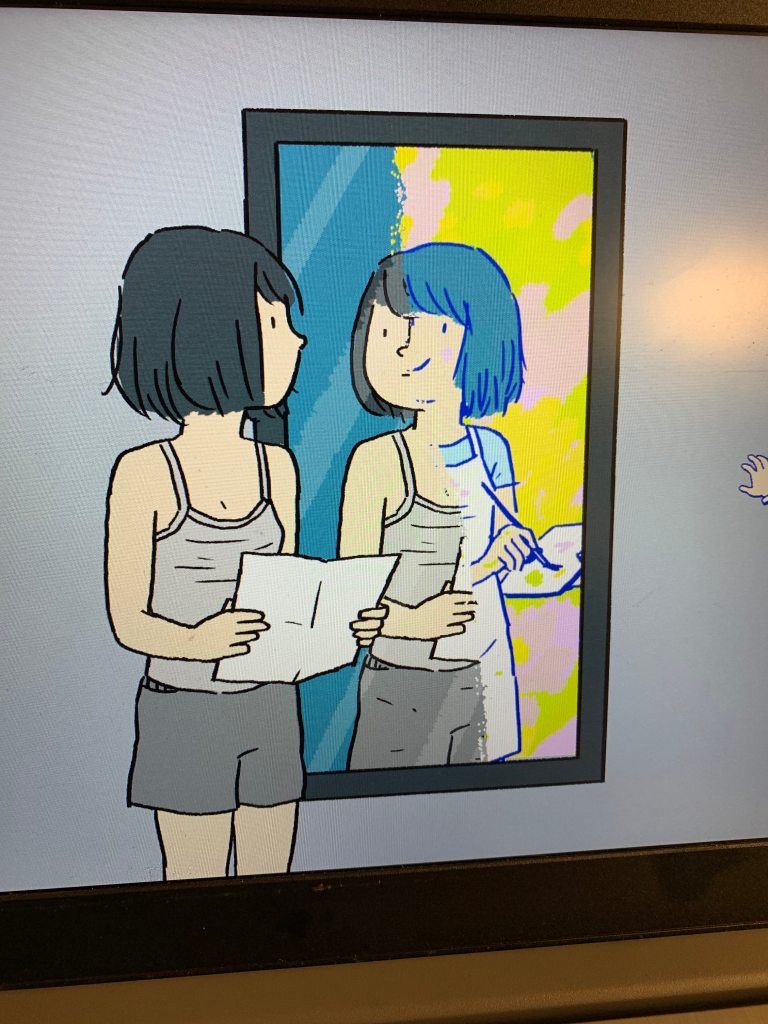
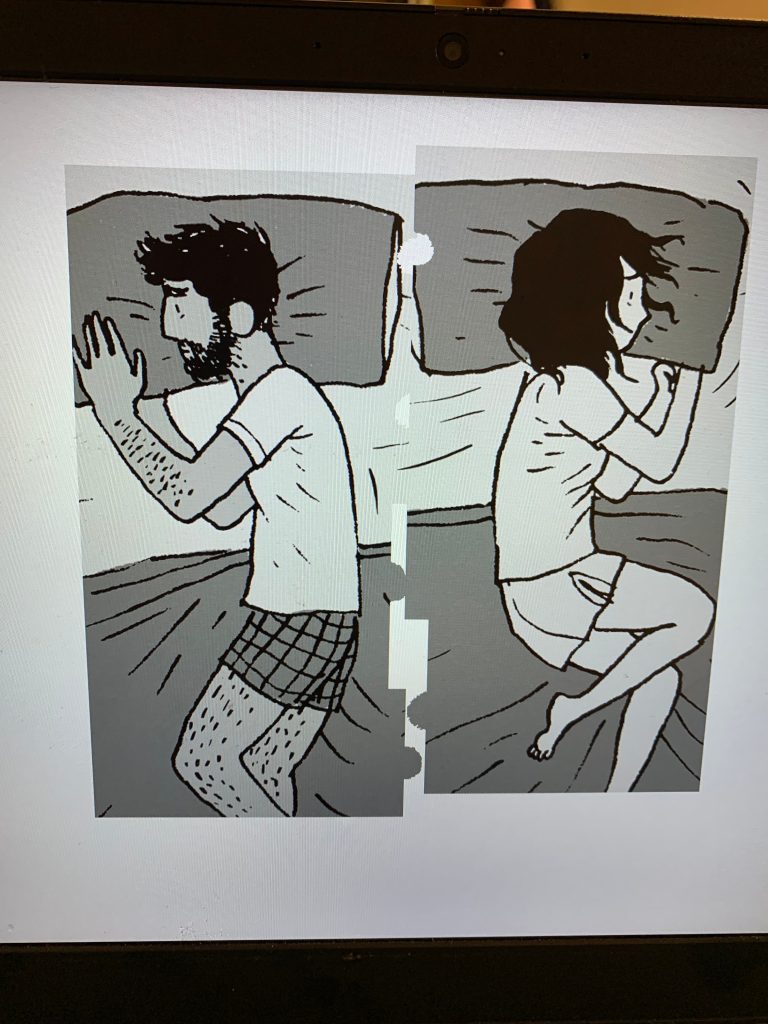
After playing this game, I discovered it had even more literary worth than I originally thought. Although there is virtually no dialogoue in the game it offered imagery rich in metaphors which advanced the plot. The aforementioned character development is also present while Florence attempts to navigate who she is and what she wants in life . The game was broken into chapters which made it feel even more like a traditional novel and would be useful in categorizing discussion questions.

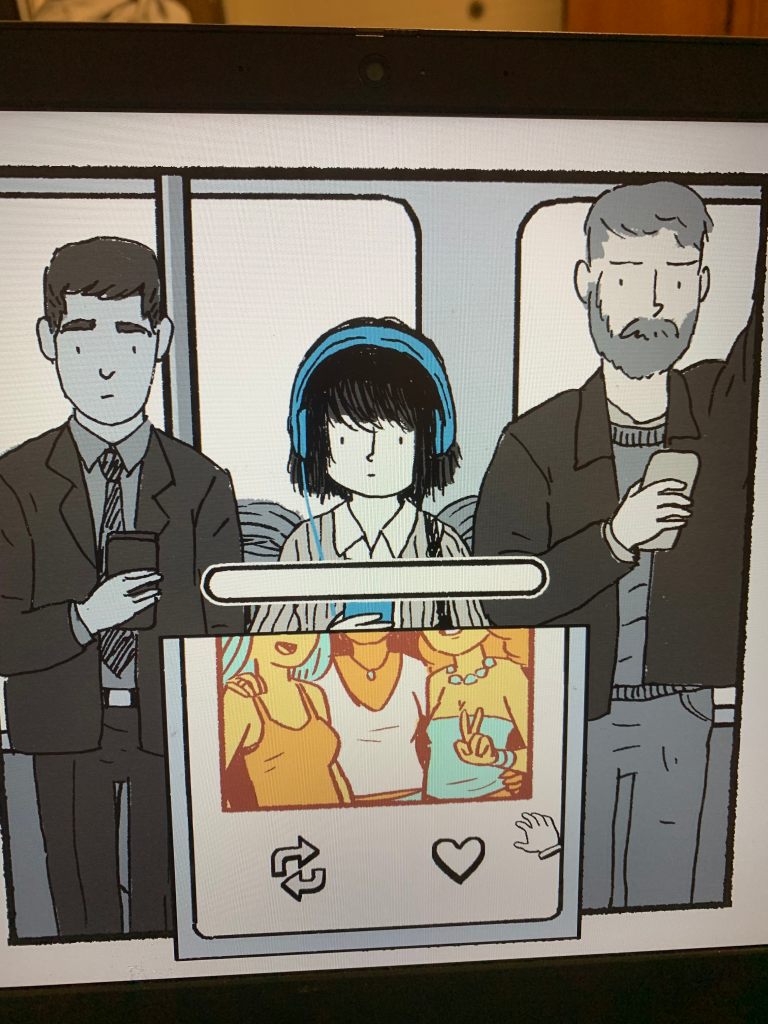
The instructions in this game that were subtle and not textual but rather movement based. For example an object that the player is supposed to drag with the mouse will grow and shake to indicate that they should manipulate that object. Florence had its instructional beginnings in well-ordered problems which is a concept Gee described as problems which “are designed to lead players to form good guesses about how to proceed when they face harder problems later on in the game.” (Gee 35). For example, the game began with Florence waking up.

One of the first motions the players had to move through was brushing her teeth. There was a toothbrush highlighted and as soon as the player started moving the brush back and forth- the character on screen began brushing her teeth. This concept would come back later in the game by manipulating different objects by shaking them, moving them, or manipulating them in some way to make the character(s) on screen react.

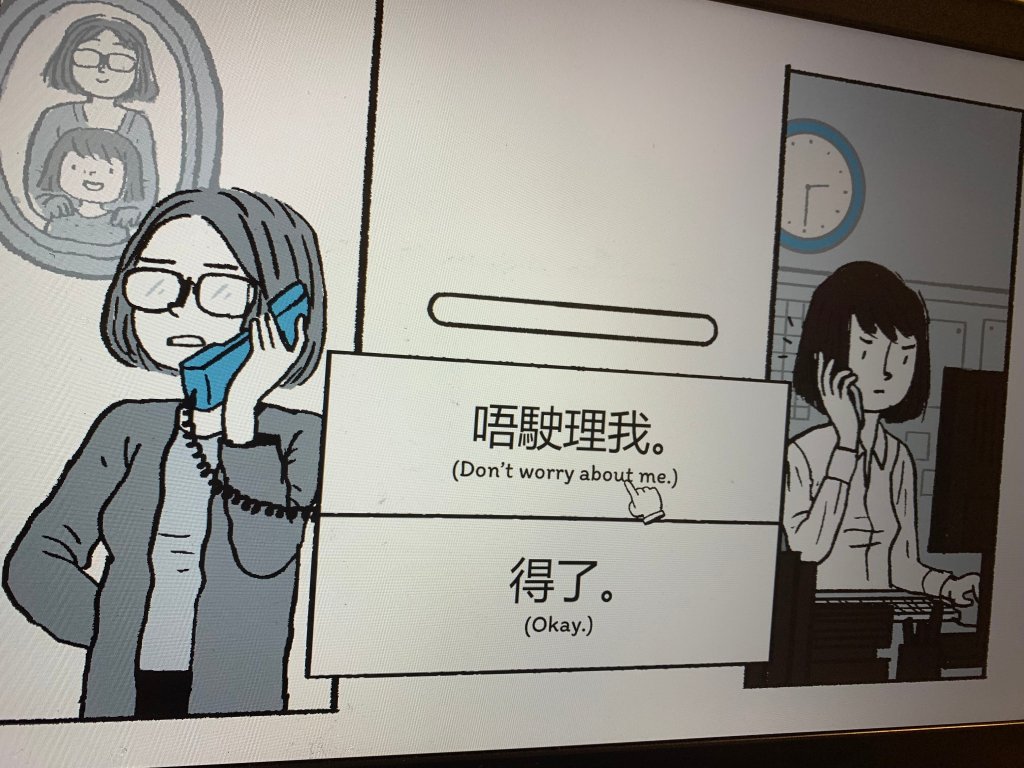
The game does not have much actual dialogue, the exception is when the character talks to her mom on the phone and can choose passive aggressive responses or passive responses.

The player notices that Florence is not content with her current life as it is the same boring routine everyday. At this point I started to realize for the most part this game does not represent Gee’s concept of “Co-Design” exceptionally well. There is the element of allowing the player to do something and the game does something back, which encourages the player to make another move or do something in return. (Gee 30) However, as far as I could tell playing this game it had a predetermined plot so the players actions don’t influence the trajectory of the game.

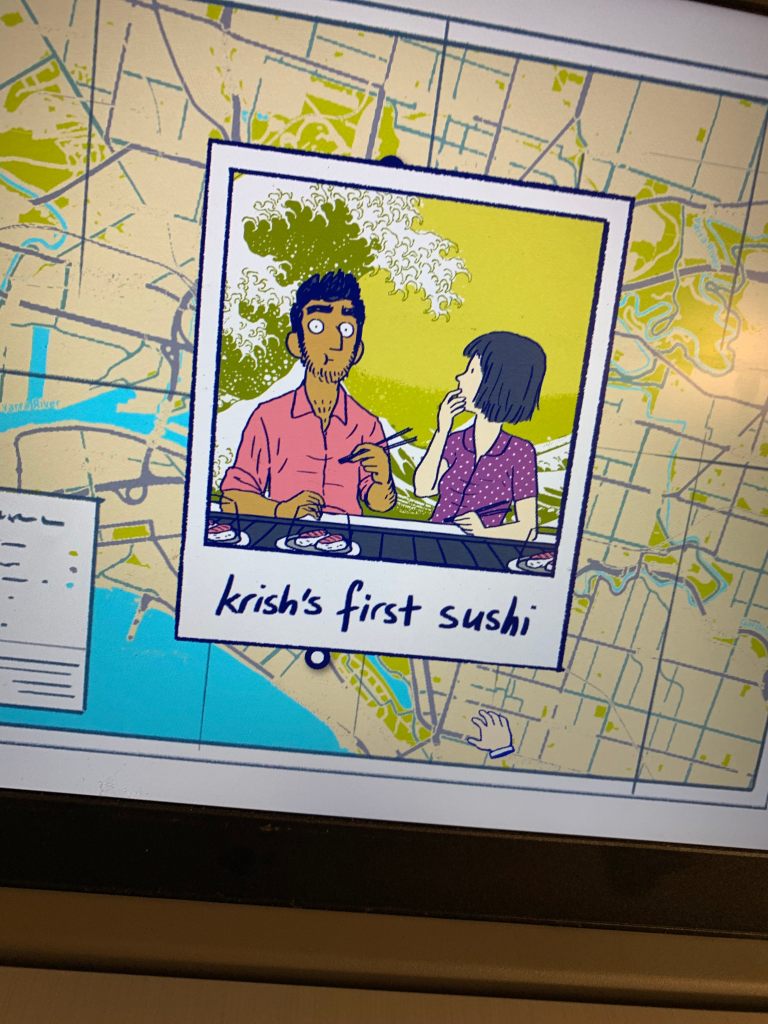
            Squire notes that a prominent aspect of video gaming is the example of how “these spaces has been the way that they allow players to explore new identities, particularly ones where they inhabit worlds through different genders,” (Squire 23)Therefore, even though this game follows a female protagonist this does not mean it won’t be an engaging experience for male students. Furthermore, the protagonist of this game is Asian and her love interest is Indian. This experience allows students who are Asian or Indian to see themselves in the video game and for students who are not to take on a new identity through gaming. Their identities are not the primary focus of the game but they do have elements throughout such as the items found in their house, the pressure Florence feels on herself to succeed, and the food they eat.

This game is a safe space to experience a real world scenario that many adolescents may be struggling with. The protagonist of Florence goes through the motions of working as a data analyst, struggling between her dream job and boring work, navigating familial relationships, navigating her romantic relationship, and finding the joy in the world again. All of these topics are found to be intriguing by adolescents who are in a crucial stage of identity development and also beginning to be curious about romantic relationships. Florence is a sandbox where students can experience the real world through a safe world (Gee 39). The game itself although sad at times is comforting with soothing music and entrancing artwork.

Overall, I would teach Florence in my ELA classroom. It was easy to learn and has the potential for significant pedagogy because it explores themes such as plot, character development, visual metaphors, and conflict.